Agent View

The site as an AI agent gets it, beside the site as a person sees it. What it can read, what it has to cut away, and what it never sees.

theconnectprogram.org28 pages read on October 23, 2026
Full screen
Is Your Community Ready? Introducing the Connect Postvention Readiness Assessment - The Connect Program – NAMI NH
theconnectprogram.org/is-your-community-ready-introducing-the-connect-postvention-readiness-assessment/

Skip to content

Skip to content

Connect is A program of NAMI NH

Get Help Now: call 988

Contact US

Image: Connect - Training Professionals & Communities in Suicide Prevention & Response

Who We AreConnect PrinciplesMeet the Connect TeamWho We TrainOrganizations & BusinessesFederal/State Agencies & CommunitiesK-12 SchoolsIndividuals & Small Groups

eLEARNING PLATFORM

Is Your Community Ready? Introducing the Connect Postvention Readiness Assessment

The rest of the page is in full screen.

Drawn from the HTML mttr fetched, not a screenshot.
page.md660 words, about 1,215 tokens
# Is Your Community Ready? Introducing the Connect Postvention Readiness Assessment

/ [Newsletter](https://theconnectprogram.org/category/newsletter/) / By [NAMI NH](https://theconnectprogram.org/author/admin/)

**When Tragedy Strikes, Readiness Can’t Wait Until Then**

When a community loses someone to suicide or another sudden death, the ripple effects reach far beyond the immediate circle of grief — coworkers, classmates, neighbors, and entire organizations can feel the impact for months or years. The communities that respond best aren’t the ones scrambling to figure out what to do in the moment. They’re the ones who took an honest look at where they stood before a crisis ever occurred.

That’s exactly what NAMI New Hampshire’s Connect™ Postvention Program helps communities do — and we’re excited to share a new tool that makes that first step easier than ever.

**Introducing the Postvention Readiness Assessment**

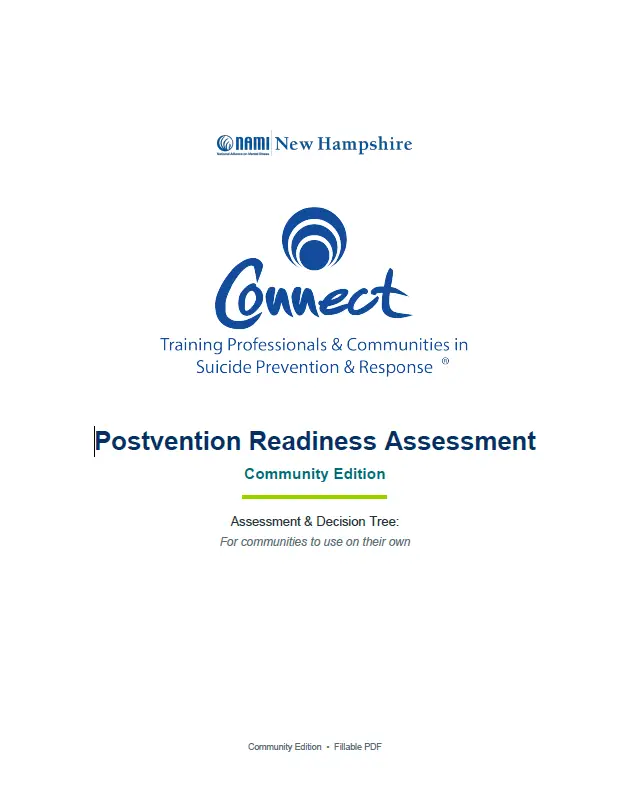
Today we’re releasing the Postvention Readiness Assessment — Community Edition, a free, self-guided toolkit that helps any organization or community gauge how prepared it is to respond to a suicide, a drug poisoning (overdose) death, or another sudden loss.

The toolkit has two parts. The Readiness Assessment walks you through seven sections and seventeen questions covering motivation, awareness, infrastructure, coordination, capacity, readiness for action, and existing strengths — plus a simple scoring guide to total your results. The Decision Tree then translates that score, along with a few real-time considerations, into a clear, recommended next step for your community.

[![Connect Postvention Readiness Assessment - Community Edition Cover Page](https://theconnectprogram.org/wp-content/uploads/2026/09/Postvention-Readiness-Community.webp)](https://theconnectprogram.org/wp-content/uploads/2026/09/Connect_Postvention_Readiness_Assessment-Community_Edition-FILLABLE.pdf)
Click to download

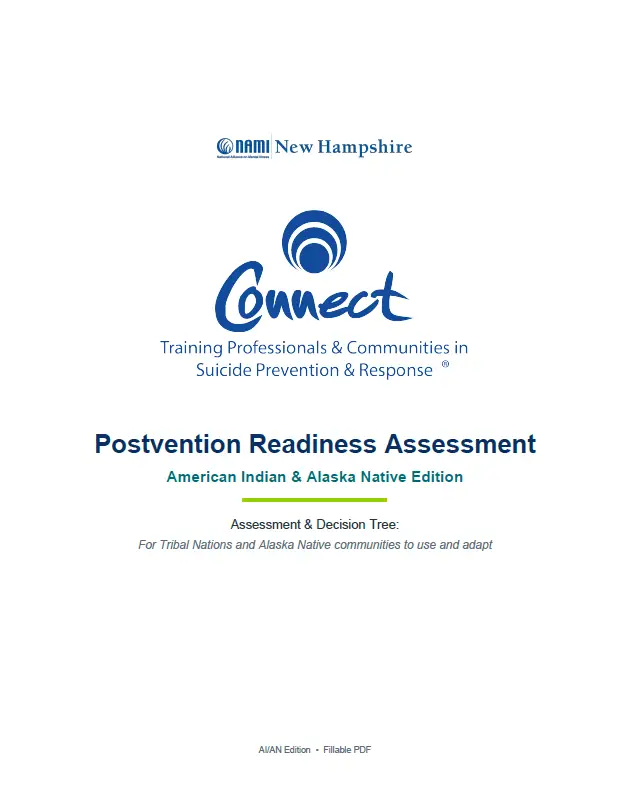
[![Connect Postvention Readiness Assessment - American Indian & Alaska Native Edition Cover Page](https://theconnectprogram.org/wp-content/uploads/2026/09/Postvention-Readiness-AIAN.webp)](https://theconnectprogram.org/wp-content/uploads/2026/09/Connect_Postvention_Readiness_Assessment-AIAN_Edition-FILLABLE.pdf)
Click to download

**Built for Two Audiences, One Goal**

We designed this edition with two groups in mind. If your community is about to reach out to NAMI NH for support, this assessment is the natural first step — our Connect team members may ask you to complete it before your first conversation, so we can meet you exactly where you are.

We’re also making it available to everyone who attends our conference sessions and workshops. Take it back to your own community, work through it with your team, and see what your results suggest. If they point toward reaching out, we’d welcome that conversation — but there’s no obligation either way.

**What’s Inside**

Each of the seven sections opens with a short description of what an actually ready community or organization looks like, so you’re not just answering questions in the abstract — you have something concrete to measure yourselves against. From there, a simple numeric scale, along with a few multiple-choice questions, builds toward a total readiness score between 6 and 25.

That score sorts into three bands — Low, Moderate, and High Readiness — each paired with a realistic recommended approach, from an introductory conversation and leadership engagement work, up through full Connect training and cross-sector planning. A red-flag checklist also flags situations, like severe staffing shortages or active conflict between partners, that should pause any plan regardless of score.

**One Tool for Suicide and Drug Poisoning (Overdose) Death**

NAMI NH’s Connect Postvention Program has long supported communities preparing for the aftermath of suicide. As we expand into supporting communities affected by drug poisoning (overdose) death as well, we built this assessment to work for either — the process of building readiness looks the same, whatever form the loss takes.

There’s no wrong answer anywhere in this toolkit. A low score isn’t a failing grade — it just tells you, and us, exactly where to start. A high score doesn’t mean the work is finished. Your total is a starting point for an honest conversation, not a verdict on your community.

**Get Started**

The Postvention Readiness Assessment — Community Edition is available now. Print it, fill it out digitally, or work through it as a team at your next staff meeting.

If your results suggest it’s time to talk, or if you just want to think it through with someone, reach out to our Connect team — we’re always glad to help a community take its next step, whatever that turns out to be.

**Amy Cook, Director of Training Email:** [[email protected]](mailto:[email protected])

An agent gets this page whole: its own text is in the HTML the server sends.

The figures

28 pages, set against the 167,893 sites with figures.

Readablehigher is better
100%28 of 28 pages
All 167,893 sitesBetter than 47%

Pages whose own text is in the HTML the server sends, enough of it for their kind.

Cleanhigher is better
77%middle page
All 167,893 sitesBetter than 60%

Of the words before script, the share that are the page and not menus, footer and forms. 2 pages are not measured, with no <main> or no words.

Costshown, never scored
146,888tokens
About 5,246 a page

To read every page once. A long page that answers well is not worse for it. Tokens are estimated at about 4 characters each.

How its pages spread on Clean

Its middle, 77%

26 pages measured. Not measured: 2 with no <main> or no words.

Against its rivals

The sites nearest it by what they do, with figures. Close means similar work, not better.

No site near it by what it does has figures yet.

AI crawler access

What robots.txt says to each, as read on October 23, 2026. 8 of 8 may read the site.

Open robots.txt
Crawlerrobots.txt saysUsed forThe line that decides
GPTBotOpenAINot namedTraining modelsFalls to User-agent: *
OAI-SearchBotOpenAINot namedChatGPT searchFalls to User-agent: *
ChatGPT-UserOpenAINot namedA page a person asks aboutFalls to User-agent: *
ClaudeBotAnthropicNot namedTraining modelsFalls to User-agent: *
Claude-SearchBotAnthropicNot namedClaude’s searchFalls to User-agent: *
PerplexityBotPerplexityNot namedPerplexity searchFalls to User-agent: *
Google-ExtendedGoogleNot namedTraining GeminiFalls to User-agent: *
bingbotMicrosoftNot namedBing and CopilotFalls to User-agent: *

Every AI crawler mttr checks may read it. Not named means the rules for every crawler apply.

Every page

Worst first. Each opens in Agent View at the top.

17 pages of 28 lose something. Pick a loss to see what to do about it.Open the action plan

What an agent getshigher is betterSignalsCostnot scored
PageWordsCleanReadableMain headingTokensWhat it loses
/1,302No <main>YesNone2,991No <main> and 1 more
/who-we-train8,992No <main>YesNone18,020No <main> and 1 more
/contact-us467%YesNone108No h1
/meet-the-connect-team9021%YesNone170No h1
/connect-principles30145%YesNone631No h1
/who-we-are29845%YesNone612No h1
/training-for-federal-state-agencies-communities1,25477%YesNone2,837No h1
/training-for-students1,51281%YesNone3,361No h1
/training-for-individuals-small-groups1,57681%YesNone3,365No h1
/training-for-organizations1,87884%YesNone4,048No h1
/privacy-policy2,56888%YesNone4,181No h1
/newsletter/22,63689%YesNone4,729No h1
/newsletter5,13994%YesNone8,729No h1
/services5,49494%YesNone12,477No h1
/faq6,71595%YesNone13,162No h1
/terms-of-use7,22995%YesNone11,426No h1
/resources7,86896%YesNone16,019No h1
/why-suicide-prevention-training-belongs-in-the-workplace50260%YesYes820Nothing
/reflections-from-alaska-suicide-prevention-community-and-what-we-can-all-learn63664%YesYes1,199Nothing
/is-your-community-ready-introducing-the-connect-postvention-readiness-assessment66065%YesYes1,215Nothing
/words-matter-when-a-suicide-prevention-workshop-actually-feels-fresh70667%YesYes1,226Nothing
/returning-home-how-the-connect-program-deepens-roots-in-hawaii73467%YesYes1,301Nothing
/building-youth-leadership-across-new-hampshires-north-country90972%YesYes1,646Nothing
/from-new-hampshire-to-tennessee-how-connect-training-supports-community-healing-after-suicide-and-disaster1,13377%YesYes1,978Nothing
/walking-through-history-while-planning-for-healing-my-experience-at-clark-atlanta-university1,19877%YesYes2,050Nothing
The worst 25 of 28 pages.Show all 28

Show where it stands

A card, a badge and a line, each with the figures.

theconnectprogram.org in Agent View: 100% readable
1200 by 630, for linksDownload

A badge for the site

Agent View: 100% readable
<a href="https://mttr.si/agent-view/theconnectprogram.org"><img src="https://mttr.si/agent-view/theconnectprogram.org/badge.svg" alt="Agent View: 100% readable, 77% clean" height="20"></a>
Drawn again after every read

The figures in one line

theconnectprogram.org in Agent View: 100% of pages readable, better than 47% of sites; 77% clean; 146,888 tokens to read all 28 pages. mttr.si/agent-view/theconnectprogram.org

What to do next

Fix the pages, let an agent do it, and read the site again to see the figures move.

Fix what agents miss

17pages lose something
  • Give 17 pages a main headingClearer
  • Wrap 2 pages in <main>Clean measured
Open the action plan

Connect your agent

Claude Code, Codex or Cursor reads the site’s fixes over MCP, fixes a page in your code, has mttr read it again, and checks the fix landed.

https://mttr.si/mcp
Set up an agent

Claim the site

Prove it is yours with a DNS record or a file. Your agent can then reach its reads and jobs, and set each change to wait for your approval.

Claim the site

Drawn from the HTML mttr fetched on its read of October 23, 2026, not a screenshot, and only from the 28 pages read. An assistant’s own reader may differ. Tokens are estimated at about 4 characters each. A site an agent reads well is not a site an assistant cites.

Agent Viewtheconnectprogram.org Close Esc
Is Your Community Ready? Introducing the Connect Postvention Readiness Assessment - The Connect Program – NAMI NH
theconnectprogram.org/is-your-community-ready-introducing-the-connect-postvention-readiness-assessment/

1 of 5 images has no words, so an agent gets nothing of it.

Skip to content

Skip to content

Connect is A program of NAMI NH

Get Help Now: call 988

Contact US

Image: Connect - Training Professionals & Communities in Suicide Prevention & Response

Who We AreConnect PrinciplesMeet the Connect TeamWho We TrainOrganizations & BusinessesFederal/State Agencies & CommunitiesK-12 SchoolsIndividuals & Small Groups

eLEARNING PLATFORM

Is Your Community Ready? Introducing the Connect Postvention Readiness Assessment

/ Newsletter / By NAMI NH

When Tragedy Strikes, Readiness Can’t Wait Until Then

When a community loses someone to suicide or another sudden death, the ripple effects reach far beyond the immediate circle of grief — coworkers, classmates, neighbors, and entire organizations can feel the impact for months or years. The communities that respond best aren’t the ones scrambling to figure out what to do in the moment. They’re the ones who took an honest look at where they stood before a crisis ever occurred.

That’s exactly what NAMI New Hampshire’s Connect™ Postvention Program helps communities do — and we’re excited to share a new tool that makes that first step easier than ever.

Introducing the Postvention Readiness Assessment

Today we’re releasing the Postvention Readiness Assessment — Community Edition, a free, self-guided toolkit that helps any organization or community gauge how prepared it is to respond to a suicide, a drug poisoning (overdose) death, or another sudden loss.

The toolkit has two parts. The Readiness Assessment walks you through seven sections and seventeen questions covering motivation, awareness, infrastructure, coordination, capacity, readiness for action, and existing strengths — plus a simple scoring guide to total your results. The Decision Tree then translates that score, along with a few real-time considerations, into a clear, recommended next step for your community.

Image: Connect Postvention Readiness Assessment - Community Edition Cover Page

Click to download

Image: Connect Postvention Readiness Assessment - American Indian & Alaska Native Edition Cover Page

Click to download

Built for Two Audiences, One Goal

We designed this edition with two groups in mind. If your community is about to reach out to NAMI NH for support, this assessment is the natural first step — our Connect team members may ask you to complete it before your first conversation, so we can meet you exactly where you are.

We’re also making it available to everyone who attends our conference sessions and workshops. Take it back to your own community, work through it with your team, and see what your results suggest. If they point toward reaching out, we’d welcome that conversation — but there’s no obligation either way.

What’s Inside

Each of the seven sections opens with a short description of what an actually ready community or organization looks like, so you’re not just answering questions in the abstract — you have something concrete to measure yourselves against. From there, a simple numeric scale, along with a few multiple-choice questions, builds toward a total readiness score between 6 and 25.

That score sorts into three bands — Low, Moderate, and High Readiness — each paired with a realistic recommended approach, from an introductory conversation and leadership engagement work, up through full Connect training and cross-sector planning. A red-flag checklist also flags situations, like severe staffing shortages or active conflict between partners, that should pause any plan regardless of score.

One Tool for Suicide and Drug Poisoning (Overdose) Death

NAMI NH’s Connect Postvention Program has long supported communities preparing for the aftermath of suicide. As we expand into supporting communities affected by drug poisoning (overdose) death as well, we built this assessment to work for either — the process of building readiness looks the same, whatever form the loss takes.

There’s no wrong answer anywhere in this toolkit. A low score isn’t a failing grade — it just tells you, and us, exactly where to start. A high score doesn’t mean the work is finished. Your total is a starting point for an honest conversation, not a verdict on your community.

Get Started

The Postvention Readiness Assessment — Community Edition is available now. Print it, fill it out digitally, or work through it as a team at your next staff meeting.

If your results suggest it’s time to talk, or if you just want to think it through with someone, reach out to our Connect team — we’re always glad to help a community take its next step, whatever that turns out to be.

Amy Cook, Director of Training
Email:
[email protected]

←

Previous Post

Next Post →

Roller Chain DrivesGear CouplingsConveyor ChainsMarine BearingsSaving investmentsGear DrivesIndustrial ShaftsMechanical Drives

Image: NAMI New Hampshire - National Alliance on Mental Illness

85 North State Street
Concord, NH 03301

Information & Resource Line: 1-800-242-6264
603-225-5359 | [email protected]
IRS EIN: 22-2760743

Image with no words

A comprehensive and flexible model for planning and implementing suicide prevention and postvention best practices.

Stay Connected

Facebook-f

Icon-linkedin

Instagram

© 2018 – 2026 NAMI New Hampshire. All Rights Reserved.

Terms of Use

Privacy Policy

Scroll to Top

We use cookies

We use cookies to improve your experience on this website. You may choose which types of cookies to allow and change your preferences at any time. Disabling cookies may impact your experience on this website. You can learn more by viewing our Cookie Policy.

Drawn from the HTML mttr fetched, not a screenshot.
page.md660 words, about 1,215 tokens
# Is Your Community Ready? Introducing the Connect Postvention Readiness Assessment

/ [Newsletter](https://theconnectprogram.org/category/newsletter/) / By [NAMI NH](https://theconnectprogram.org/author/admin/)

**When Tragedy Strikes, Readiness Can’t Wait Until Then**

When a community loses someone to suicide or another sudden death, the ripple effects reach far beyond the immediate circle of grief — coworkers, classmates, neighbors, and entire organizations can feel the impact for months or years. The communities that respond best aren’t the ones scrambling to figure out what to do in the moment. They’re the ones who took an honest look at where they stood before a crisis ever occurred.

That’s exactly what NAMI New Hampshire’s Connect™ Postvention Program helps communities do — and we’re excited to share a new tool that makes that first step easier than ever.

**Introducing the Postvention Readiness Assessment**

Today we’re releasing the Postvention Readiness Assessment — Community Edition, a free, self-guided toolkit that helps any organization or community gauge how prepared it is to respond to a suicide, a drug poisoning (overdose) death, or another sudden loss.

The toolkit has two parts. The Readiness Assessment walks you through seven sections and seventeen questions covering motivation, awareness, infrastructure, coordination, capacity, readiness for action, and existing strengths — plus a simple scoring guide to total your results. The Decision Tree then translates that score, along with a few real-time considerations, into a clear, recommended next step for your community.

[![Connect Postvention Readiness Assessment - Community Edition Cover Page](https://theconnectprogram.org/wp-content/uploads/2026/09/Postvention-Readiness-Community.webp)](https://theconnectprogram.org/wp-content/uploads/2026/09/Connect_Postvention_Readiness_Assessment-Community_Edition-FILLABLE.pdf)

Click to download

[![Connect Postvention Readiness Assessment - American Indian & Alaska Native Edition Cover Page](https://theconnectprogram.org/wp-content/uploads/2026/09/Postvention-Readiness-AIAN.webp)](https://theconnectprogram.org/wp-content/uploads/2026/09/Connect_Postvention_Readiness_Assessment-AIAN_Edition-FILLABLE.pdf)

Click to download

**Built for Two Audiences, One Goal**

We designed this edition with two groups in mind. If your community is about to reach out to NAMI NH for support, this assessment is the natural first step — our Connect team members may ask you to complete it before your first conversation, so we can meet you exactly where you are.

We’re also making it available to everyone who attends our conference sessions and workshops. Take it back to your own community, work through it with your team, and see what your results suggest. If they point toward reaching out, we’d welcome that conversation — but there’s no obligation either way.

**What’s Inside**

Each of the seven sections opens with a short description of what an actually ready community or organization looks like, so you’re not just answering questions in the abstract — you have something concrete to measure yourselves against. From there, a simple numeric scale, along with a few multiple-choice questions, builds toward a total readiness score between 6 and 25.

That score sorts into three bands — Low, Moderate, and High Readiness — each paired with a realistic recommended approach, from an introductory conversation and leadership engagement work, up through full Connect training and cross-sector planning. A red-flag checklist also flags situations, like severe staffing shortages or active conflict between partners, that should pause any plan regardless of score.

**One Tool for Suicide and Drug Poisoning (Overdose) Death**

NAMI NH’s Connect Postvention Program has long supported communities preparing for the aftermath of suicide. As we expand into supporting communities affected by drug poisoning (overdose) death as well, we built this assessment to work for either — the process of building readiness looks the same, whatever form the loss takes.

There’s no wrong answer anywhere in this toolkit. A low score isn’t a failing grade — it just tells you, and us, exactly where to start. A high score doesn’t mean the work is finished. Your total is a starting point for an honest conversation, not a verdict on your community.

**Get Started**

The Postvention Readiness Assessment — Community Edition is available now. Print it, fill it out digitally, or work through it as a team at your next staff meeting.

If your results suggest it’s time to talk, or if you just want to think it through with someone, reach out to our Connect team — we’re always glad to help a community take its next step, whatever that turns out to be.

**Amy Cook, Director of Training Email:** [[email protected]](mailto:[email protected])
Drawn from the HTML mttr fetched, not a screenshot. An assistant’s own reader may differ.Tokens are estimated at about 4 characters each.
