Agent View
The site as an AI agent gets it, beside the site as a person sees it. What it can read, what it has to cut away, and what it never sees.
- Menu
goal $10000 $6316 donated Share
Achillea millefolium (Common Yarrow)
| Also known as: | |
|---|---|
| Genus: | Achillea |
| Family: | Asteraceae (Aster) |
| Life cycle: | perennial |
| Origin: | native |
| Habitat: | part shade, sun; fields, prairies, open woods. roadsides |
The rest of the page is in full screen.
- [Menu](https://minnesotawildflowers.info/flower/common-yarrow#nav)
# 
goal $10000
$6316 donated
[](https://minnesotawildflowers.info/page/donations)
## Share
## *Achillea millefolium* (Common Yarrow)
| Also known as: | |
| --- | --- |
| Genus: | [Achillea](https://minnesotawildflowers.info/search?scientific_name=Achillea&wh) |
| Family: | [Asteraceae (Aster)](https://minnesotawildflowers.info/search?family=Asteraceae&wh) |
| Life cycle: | perennial |
| Origin: | native |
| Habitat: | part shade, sun; fields, prairies, open woods. roadsides |
| Bloom season: | June - September |
| Plant height: | 1 to 3 feet |
| [Wetland Indicator Status](https://minnesotawildflowers.info/page/glossary#wis): | GP: FACU MW: FACU NCNE: FACU |
| MN county distribution (click map to enlarge): | [](https://minnesotawildflowers.info/udata/r9ndp23q/maps/achmil.png) |
| National distribution (click map to enlarge): | [](https://minnesotawildflowers.info/includes/modalfiles/bonap.php?s=achmil) |
Pick an image for a larger view. See the [glossary](https://minnesotawildflowers.info/page/glossary) for icon descriptions.
### Detailed Information
#### Flower:  
[](https://minnesotawildflowers.info/udata/r9ndp23q/pd/achillea-millifolium1.jpg) Flat clusters 2 to 4 inches across at the end of branching stems in the upper part of the plant. Individual flowers are about ¼ inch across and have 4 to 6 white to pink ray flowers (petals), notched at the tips, and cream colored or pale yellow disc flowers.
#### Leaves:   
[](https://minnesotawildflowers.info/udata/r9ndp23q/pd/achillea-millefolium-07-3.jpg) Leaves are narrow and finely divided, feathery and fern-like, up to 6 inches long and 1 inch across and are progressively smaller towards the top of the stem. The leaves and/or stem are often covered in fine hairs, but not always.
#### Fruit: 
[](https://minnesotawildflowers.info/udata/r9ndp23q/white/achillea-millefolium-common-yarrow_1130_155615.jpg) The flower heads become oval-elliptic seed heads, drying to brown and may persist into winter. Fruit is a dry seed 1 to 2 mm long.
#### Notes:
According to Flora of North America (FNA) this species is native, though morphologically variable. FNA goes on to explain that some early botanists considered the variations separate species, others considered them variations of a single species. It seems now this is a Northern Hemisphere species that has hybridized sufficiently between North American and introduced plants to become a single, variable species. While most references treat it as native to North America, the DNR is undecided about its status in MN. We'll go with native for now. Per the county distribution map, Common Yarrow has been found in every Minnesota county except Stevens and Waseca, but in all likelihood it exists there, just hasn't been recorded. While the individual flowers may resemble [Sneezewort](https://minnesotawildflowers.info/flower/sneezewort) (*Achillea ptarmica*), the latter has larger and fewer flowers with more than 6 rays, and leaves that are lance-linear, not finely divided.
### Native Plant Nurseries, Restoration and Landscaping Services ↓
[Map of native plant resources in the upper midwest](https://minnesotawildflowers.info/page/native-plant-purveyor-locations)
- [](http://www.outbacknursery.com/)
- [](https://windflowernatives.com/)
- [](https://www.kinninatives.com/)
- [](https://northernholler.com/)
- [](http://www.prairiemoon.com/)
### More photos
- [Common Yarrow plants](https://minnesotawildflowers.info/udata/r9ndp23q/pd/achillea-millifolium-3.jpg)
- [more plants](https://minnesotawildflowers.info/udata/r9ndp23q/white/common-yarrow_0619_083330.jpg)
- [pink flowers](https://minnesotawildflowers.info/udata/r9ndp23q/white/common-yarrow_0615_113336.jpg)
Photos by K. Chayka taken in Ramsey County. Photos courtesy Peter M. Dziuk taken in Anoka and Lake counties.
### Comments
**Have you seen this plant in Minnesota,** or have any other comments about it?
Posted by: Robyn - Litchfield
on: 2010-05-31 18:36:35
It grows all over in Litchfield. A great medicinal herb! God for bruises, burns, radiation, takes pain away from varicose veins, sunburn, but it is renowned for its ability to stop the blood from gushing wounds. Hence it's name "Achillea millefolium", named after the Greek leader of warriors in the Trojan War, who bound the wounds of his warriors with yarrow to staunch the flow of their blood.
Posted by: Nancy
on: 2010-06-20 13:08:33
achillia multifolia is labeled as "native" on your Minnesota Wildflowers site, but as alien in Roger Tory Peterson's Field Guide to Wildflowers, and on the USDA website. Is this an "oops" or do you have other information on this plant?
Posted by: K. Chayka
on: 2010-06-21 21:38:50
Nancy, thanks for this particular question, as I have asked it myself.
According to Flora of North America ("FNA" is our definitive guide, see FloraNorthAmerica.org) this species is native, though morphologically variable. FNA goes on to explain that some early botanists considered the variations separate species, others considered them variations of a single species. It seems now this is a Northern Hemisphere species that has hybridized sufficiently between North American and introduced plants to become a single, variable species.
FNA calls it native. The MN DNR big list-o-plants calls it "undecided", so it's open to debate.
Posted by: JoAnn - Mounds View
on: 2011-05-16 09:56:11
I have it growing in front of my house. It really seems invasive to me. My grass is almost all yarrow in places. One good thing--it mows nicely, and stays green when the grass is turning brown! The underground root system is almost impossible to get rid of.
Posted by: Ruth - Ogilvie
on: 2011-07-14 10:50:58
I have difficulty telling the difference between yarrow and Queen Anne's Lace. I have heard the the Lace is toxic. Is there some distinction to help determine which is which?
Posted by: K. Chayka
on: 2011-07-14 11:09:42
There are a number of differences between these two species that you could look for, such as:
- QAL has very showy bracts under the flower cluster, yarrow has none
- yarrow leaves are much more finely feathered, QAL leaves (and leaflets) are much broader
- yarrow flower petals are all the same size and almost square, with small notches at the tip, QAL petals are rounded at the tips and variable in size
Does that help?
Posted by: David - Douglas county, near Alexandria
on: 2013-07-05 16:31:35
We started a small native prairie restoration on sandy soil at our lake cabin. We used a seed mix from a highly regarded source, containing under 1% yarrow. By year three we had a lovely stand with heavy Black-eyed Susan, grays headed coneflower, and a mix of others. This year, yarrow has taken over 90% of the area behind our house, crowding out the other plants. I would definitely call this an undesirable invasive. Is there any other option beside Rounduo to manage the yarrow?
Posted by: chrisdee - My front yard in Mounds View
on: 2014-07-22 00:20:09
Last year My Mom's neighbor asked if she'd like some ferns. I took some too only to find out when they bloomed they weren't ferns they were yellow yarrow. They are very invasive in my front flower bed, easily crowding out the other plants. I have been pulling them out by the root to keep them under control. The foliage is pleasant but the blooms are homely. They only stay yellow for a very short time and then they darken. So I pull the flower heads off too. A lot of work but as I said the foliage is pretty.
Posted by: Michael - Chaska
on: 2016-07-03 09:39:30
The garden stores sell Yarrow in all sorts of colors. We are planting a pollinator garden. Do the "unnatural" colors attract bees & butterflies as well as the natural ones?
Posted by: K. Chayka
on: 2016-07-03 11:55:26
Michael, the yarrow found in garden centers is not necessarily a native species. Regardless, while the study of native cultivars and pollinators is in its infancy, preliminary findings show that they are not as attractive to insects as the straight species.
Posted by: Gabe M - Goodhue Co.
on: 2016-07-20 13:23:04
Just curious if there is a way to differentiate between the subspecies. Specifically, var. millefolium from var. occidentalis. In my research, it shows that the var. occidentalis is native to the US, whereas the var. millefolium is European. We assume to have both here, but I don't know how to verify that claim.
Posted by: K. Chayka
on: 2016-07-20 14:38:25
According to Flora of North America, the North American and European species have hybridized sufficiently where it isn't really possible to tell them apart, nor can it be confirmed a "pure" strain still exists.
Posted by: trish - littlefork
on: 2018-09-21 11:00:45
is yarrow & queen anne's lace related? or different names for the same plant? or just similar in appearance?
Posted by: K. Chayka
on: 2018-09-21 17:29:06
Trish, those two are unrelated. Queen Anne's lace is in the carrot family and yarrow is in the aster family. The only thing they really have in common is the both have white flowers and finely divided leaves, but even they look very different side by side.
Posted by: Sara - Lac qui Parle county
on: 2019-06-18 22:28:24
I'm having trouble distinguishing between common yarrow and caraway? I'm fairly certain what is growing in our area is common yarrow as it is a DNR wildlife area that was recently reseeded with native grasses and flowers.
Posted by: K. Chayka
on: 2019-06-18 22:53:27
Sara, take a close look at the flowers: yarrow has tiny flowers in the center disk where caraway has more of a smooth, dome-shaped disk without tiny flowers. The arrangement is different, too: yarrow has branching clusters where caraway has umbels, so all its flower stalks come from the same point, like the ribs of an umbrella.
Posted by: K - Kelly Lake
on: 2022-07-03 16:46:16
It grows in small bursts in my yard.
Posted by: Rolf Erdahl - Apple Valley
on: 2022-09-01 13:53:06
What animal species depend on Yarrow? We want to encourage pollinators and butterflies, but our yarrow is getting a little thick and we are thinking of thinning it out. Any other qualities that are good for its proximity to gardens (repelling pests, encouraging good predator insects, companion plants)?
Posted by: K Chayka
on: 2022-09-01 16:39:41
Rolf, I know of no insect species that depends on yarrow above other plants. It serves generalists that would be served by many other pollen and nectar producing plants, too. The foliage is consumed by some insects. It has no value to other wildlife, as mammals tend to avoid it.
Posted by: Molly - Waseca city limits
on: 2023-06-26 12:56:54
It's growing right outside my office window.
Posted by: Jon Folkedahl - Cedar Island Lake, Richmond
on: 2024-09-17 22:21:04
I used to see lots of yarrow growing up in northern Mn but not so much in south central Mn where I now live. This year, however, the roadsides are full of yarrow, all summer. Is it because of the record rainfall after the drought years?
## Follow Minnesota Wildflowers
[](https://www.facebook.com/MinnesotaWildflowers)
[](https://minnesotawildflowers.info/mnwf-rss.xml)
Funding provided in part by the [Minnesota Environment and Natural Resources Trust Fund](http://www.lccmr.leg.mn/projects/2014/2014_recommendations.html) as recommended by the Legislative-Citizen Commission on Minnesota Resources.
Web design and content copyright © 2006-2026 MinnesotaWildflowers.info. See [Terms of Use](https://minnesotawildflowers.info/page/terms-of-use) and [Privacy Policy](https://minnesotawildflowers.info/page/privacy-policy).
Help [support this site](https://minnesotawildflowers.info/page/donations) ~ Information for [sponsor opportunities](https://minnesotawildflowers.info/page/advertising-opportunities).No <main>: Wrap the page’s own content in <main>, so a reader knows where it starts and stops, and Clean can be measured.
The figures
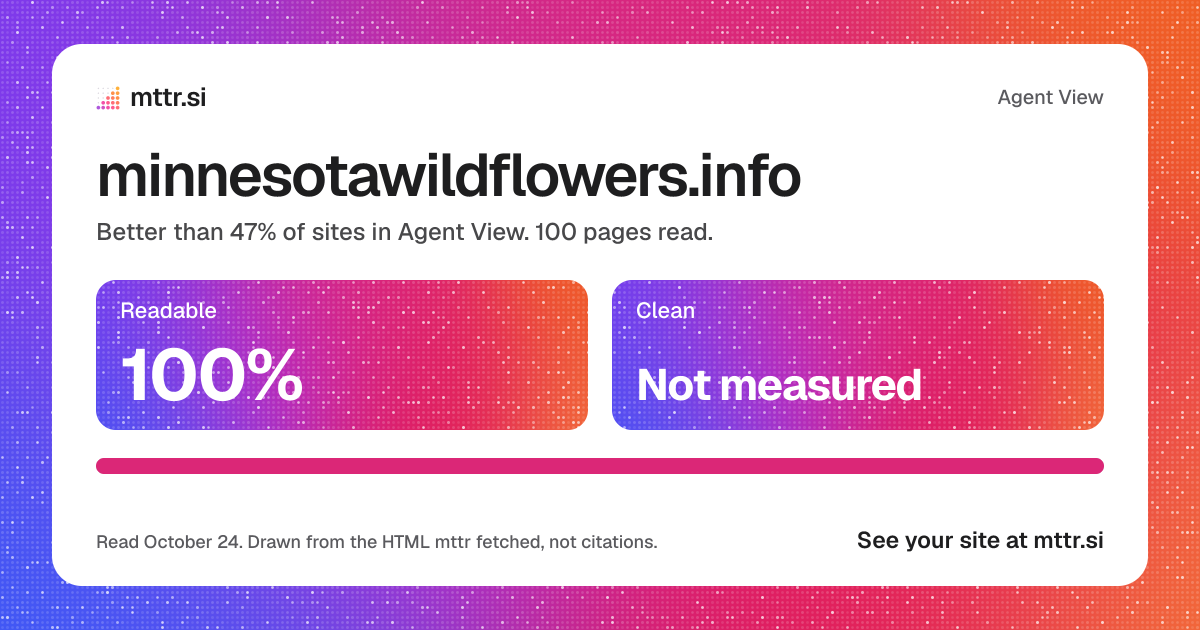
100 pages, set against the 167,893 sites with figures.
- Readablehigher is better
- 100%100 of 100 pages
- All 167,893 sitesBetter than 47%
Pages whose own text is in the HTML the server sends, enough of it for their kind.
- Cleanhigher is better
- Nonemiddle page
- All 167,893 sitesNo place yetWith no figure, it has no place.
Of the words before script, the share that are the page and not menus, footer and forms. 100 pages are not measured, with no <main> or no words.
- Costshown, never scored
- 290,565tokens
- About 2,906 a page
To read every page once. A long page that answers well is not worse for it. Tokens are estimated at about 4 characters each.
How its pages spread on Clean
0 pages measured. Not measured: 100 with no <main> or no words.
Against its rivals
The sites nearest it by what they do, with figures. Close means similar work, not better.
| Readinghigher is better | Costnot scored | ||
|---|---|---|---|
| Site | Readable | Clean | Tokens a page |
| minnesotawildflowers.infoThis site, 100 pages | 100% | None | 2,906 |
| rethinkinglawns.com54 pages | 100% | 27% | 406 |
| mnnicelandscapes.com100 pages | 72% | 63% | 819 |
| fireflyforest.com85 pages | 93% | None | 1,774 |
First of 4 on Readable.
AI crawler access
What robots.txt says to each, as read on October 24, 2026. 8 of 8 may read the site.
| Crawler | robots.txt says | Used for | The line that decides |
|---|---|---|---|
| GPTBotOpenAI | Not named | Training models | Falls to User-agent: * |
| OAI-SearchBotOpenAI | Not named | ChatGPT search | Falls to User-agent: * |
| ChatGPT-UserOpenAI | Not named | A page a person asks about | Falls to User-agent: * |
| ClaudeBotAnthropic | Not named | Training models | Falls to User-agent: * |
| Claude-SearchBotAnthropic | Not named | Claude’s search | Falls to User-agent: * |
| PerplexityBotPerplexity | Not named | Perplexity search | Falls to User-agent: * |
| Google-ExtendedGoogle | Not named | Training Gemini | Falls to User-agent: * |
| bingbotMicrosoft | Not named | Bing and Copilot | Falls to User-agent: * |
Every AI crawler mttr checks may read it. Not named means the rules for every crawler apply.
Every page
Worst first. Each opens in Agent View at the top.
100 pages of 100 lose something. Pick a loss to see what to do about it.Open the action plan
| What an agent getshigher is better | Signals | Costnot scored | ||||
|---|---|---|---|---|---|---|
| Page | Words | Clean | Readable | Main heading | Tokens | What it loses |
| / | 632 | No <main> | Yes | None | 1,765 | No <main> |
| /flower/absinthium | 1,107 | No <main> | Yes | None | 2,763 | No <main> |
| /flower/allegheny-vine | 1,206 | No <main> | Yes | None | 2,675 | No <main> |
| /flower/american-birds-foot-trefoil | 922 | No <main> | Yes | None | 2,348 | No <main> |
| /flower/american-hog-peanut | 3,665 | No <main> | Yes | None | 6,212 | No <main> |
| /flower/american-pasqueflower | 1,986 | No <main> | Yes | None | 3,967 | No <main> |
| /flower/angelica | 960 | No <main> | Yes | None | 2,344 | No <main> |
| /flower/biennial-wormwood | 651 | No <main> | Yes | None | 1,853 | No <main> |
| /flower/blue-giant-hyssop | 1,892 | No <main> | Yes | None | 3,632 | No <main> |
| /flower/canada-anemone | 1,771 | No <main> | Yes | None | 3,516 | No <main> |
| /flower/carolina-anemone | 716 | No <main> | Yes | None | 2,019 | No <main> |
| /flower/chinese-chives | 1,299 | No <main> | Yes | None | 2,807 | No <main> |
| /flower/common-burdock | 4,180 | No <main> | Yes | None | 7,227 | No <main> |
| /flower/common-ragweed | 779 | No <main> | Yes | None | 2,074 | No <main> |
| /flower/common-yarrow | 1,699 | No <main> | Yes | None | 3,441 | No <main> |
| /flower/desert-madwort | 595 | No <main> | Yes | None | 1,790 | No <main> |
| /flower/dog-fennel | 600 | No <main> | Yes | None | 1,855 | No <main> |
| /flower/downy-agrimony | 944 | No <main> | Yes | None | 2,591 | No <main> |
| /flower/dragons-mouth | 735 | No <main> | Yes | None | 1,812 | No <main> |
| /flower/earleaf-false-foxglove | 827 | No <main> | Yes | None | 2,390 | No <main> |
| /flower/eastern-dwarf-mistletoe | 631 | No <main> | Yes | None | 1,847 | No <main> |
| /flower/false-dandelion | 806 | No <main> | Yes | None | 2,000 | No <main> |
| /flower/field-pussytoes | 2,485 | No <main> | Yes | None | 4,851 | No <main> |
| /flower/field-sagewort | 553 | No <main> | Yes | None | 1,706 | No <main> |
| /flower/fools-parsley | 841 | No <main> | Yes | None | 2,443 | No <main> |
Show where it stands
A card, a badge and a line, each with the figures.
A badge for the site

<a href="https://mttr.si/agent-view/minnesotawildflowers.info"><img src="https://mttr.si/agent-view/minnesotawildflowers.info/badge.svg" alt="Agent View: 100% readable" height="20"></a>
The figures in one line
minnesotawildflowers.info in Agent View: 100% of pages readable, better than 47% of sites; Clean not measured; 290,565 tokens to read all 100 pages. mttr.si/agent-view/minnesotawildflowers.info
What to do next
Fix the pages, let an agent do it, and read the site again to see the figures move.
Fix what agents miss
- Wrap 100 pages in <main>Clean measured
Connect your agent
Claude Code, Codex or Cursor reads the site’s fixes over MCP, fixes a page in your code, has mttr read it again, and checks the fix landed.
https://mttr.si/mcpSet up an agent
Claim the site
Prove it is yours with a DNS record or a file. Your agent can then reach its reads and jobs, and set each change to wait for your approval.
Claim the siteDrawn from the HTML mttr fetched on its read of October 24, 2026, not a screenshot, and only from the 100 pages read, where the read stopped at its page limit. An assistant’s own reader may differ. Tokens are estimated at about 4 characters each. A site an agent reads well is not a site an assistant cites.